




Jun
Polyvinyl chloride (PVC) pipes have long been favored in the construction of drinking water distribution systems due to their durability, low cost, and ease of installation. However, increasing attention has been directed toward the potential health risks associated with PVC leaching – the process whereby chemicals used in PVC manufacturing migrate into drinking water. Understanding the mechanisms of chemical migration, the possible health implications of exposure to phthalates and other contaminants, and the regulatory frameworks is essential for making informed decisions regarding water safety.
What’s the Problem?
PVC pipes are widely used globally for water distribution due to their strength and resistance to corrosion, particularly in environments where traditional materials fail. However, recent studies have raised alarms over the long-term durability of PVC and the risk of chemical leaching into drinking water. Among these leachates are phthalates, commonly used as plasticizers, along with other volatile organic compounds (VOCs), which may pose health risks with prolonged exposure.
A coalition of U.S. environmental advocacy groups has issued a warning about the potential health risks associated with PVC plastic and has urged public officials to reconsider its use in community drinking water pipes.
PVC, which is derived from vinyl chloride, a hazardous substance that played a role in the alarming train derailment incident in East Palestine, Ohio, poses significant health risks. This material is recognized as a carcinogen and endocrine disruptor.
Despite these risks, the low cost of PVC – polyvinyl chloride – has made it a popular choice for communities undertaking the replacement of aging drinking water infrastructure, particularly those replacing lead pipes and service lines that also present serious public health concerns. In response to these issues, the U.S. administration allocated $15 billion in 2021 through the U.S. Environmental Protection Agency’s Drinking Water State Revolving Fund to support communities nationwide in their efforts to eliminate lead service lines.
How Contaminants Migrate from PVC Pipes
PVC leaching is a process where additives, such as phthalates, migrate from the pipe material into the water that passes through it. Over time, factors such as temperature, contact time, and water treatment processes can enhance this migration. Studies have shown that the degree of leaching can vary significantly depending on these variables.
The coalition report’s contributors criticized the EPA for issuing no guidance on which piping materials should be used for such projects.
In the months and years ahead, this new federal money will be flowing to state and local governments, and it’s unfortunate the EPA is not providing any guidance on what is a safe substitute for lead service line pipes,
said Judith Enck, a former regional EPA administrator and the president of Beyond Plastics, a nonprofit environmental group based at Bennington College, Vermont.
Beyond Plastics released the report along with two other nonprofit environmental advocacy groups: Environmental Health Sciences and the Plastic Pollution Coalition.
EPA spokeswoman Dominique Joseph did not respond directly to the criticism but confirmed the agency has no requirements for plumbing materials except that they be lead free. She said that the EPA “supports independent, third-party testing standards for plumbing materials under NSF/ANSI 61*, which has been incorporated into many state and local plumbing codes.
*NSF stands for the National Sanitation Foundation, and ANSI stands for the American National Standards Institute.
A lead water service line from 1927 lays on the ground on a residential street after being removed on June 17, 2021, in Denver. Some 9.2 million lead pipes carry water into homes across the U.S., with more in Florida than any other state, according to an Environmental Protection Agency survey that will dictate how billions of dollars to find and replace those pipes are spent.
Enck expressed concerns, stating,
the report raises legitimate concerns about the health consequences from chemicals in PVC pipes leaching into the drinking water. Instead of PVC or CPVC – chlorinated polyvinyl chloride
Enck elaborated, “communities should use safer alternatives like stainless steel or copper even if those materials cost more”. During a virtual news conference, she highlighted,
The price is paid widely and for decades through health care costs and tax dollars.
While the Consumer Product Safety Commission banned vinyl chloride in aerosols in 1974, this harmful chemical is still found in other products and remains a crucial ingredient in PVC pipes.
The global market for PVC pipes continues to grow, driven partly by rising demand for these materials in water, sewage, and irrigation systems, as detailed in several industry trend reports.
A 2021 survey conducted by Accountability Information Management, a marketing research company, revealed that PVC is favored for water infrastructure projects. The survey, which included over 200 contractors, engineers, and municipal officials, indicated that respondents expect to utilize PVC pipes for nearly 65% of all water projects.
However, some communities are opting for different materials. For instance, the city of Troy, New York, has chosen to use copper for its lead service line replacement project, according to Frank Sainato, Troy’s deputy director of public information.
We only use copper, because copper is tried and true,” he said. “It may cost more, but public safety is always worth the extra expense.
Meanwhile, Rochester, New York, located just three hours to the west, has also decided against PVC for its lead service line replacement program, as noted by public information director Barbara Pierce.
“The City of Rochester does not use PVC or CPVC for water service material, instead it uses copper and cross-linked polyethylene pipe, which does not contain polyvinyl chloride or vinyl chloride,” Pierce stated in an email to USA TODAY.
“All water service pipe the city uses – along with all other materials used in the water system – is certified for use in potable water systems by the National Sanitation Foundation, AWWA, and approved for use by both USEPA and NYSDOH.”
A representative from Uni-Bell PVC Pipe Association – a national nonprofit that claims to be ‘the authoritative source of information on PVC water, sewer, and reclaimed water pipe’ – mentioned that no one at the organization would comment on the report.
In a statement to USA TODAY, a spokesman for the American Chemistry Council did not specifically refute the report but noted that “PVC generates 35-45% less lifecycle greenhouse gas emissions compared to iron pipes.” Furthermore, he emphasized that PVC pipes used for delivering drinking water are certified by NSF International to comply with EPA safety regulations.
Along with addressing the health risks posed by PVC chemicals leaching into the water supply, the report also highlighted the health and environmental impacts associated with the production of vinyl chloride, a key component in PVC manufacturing.
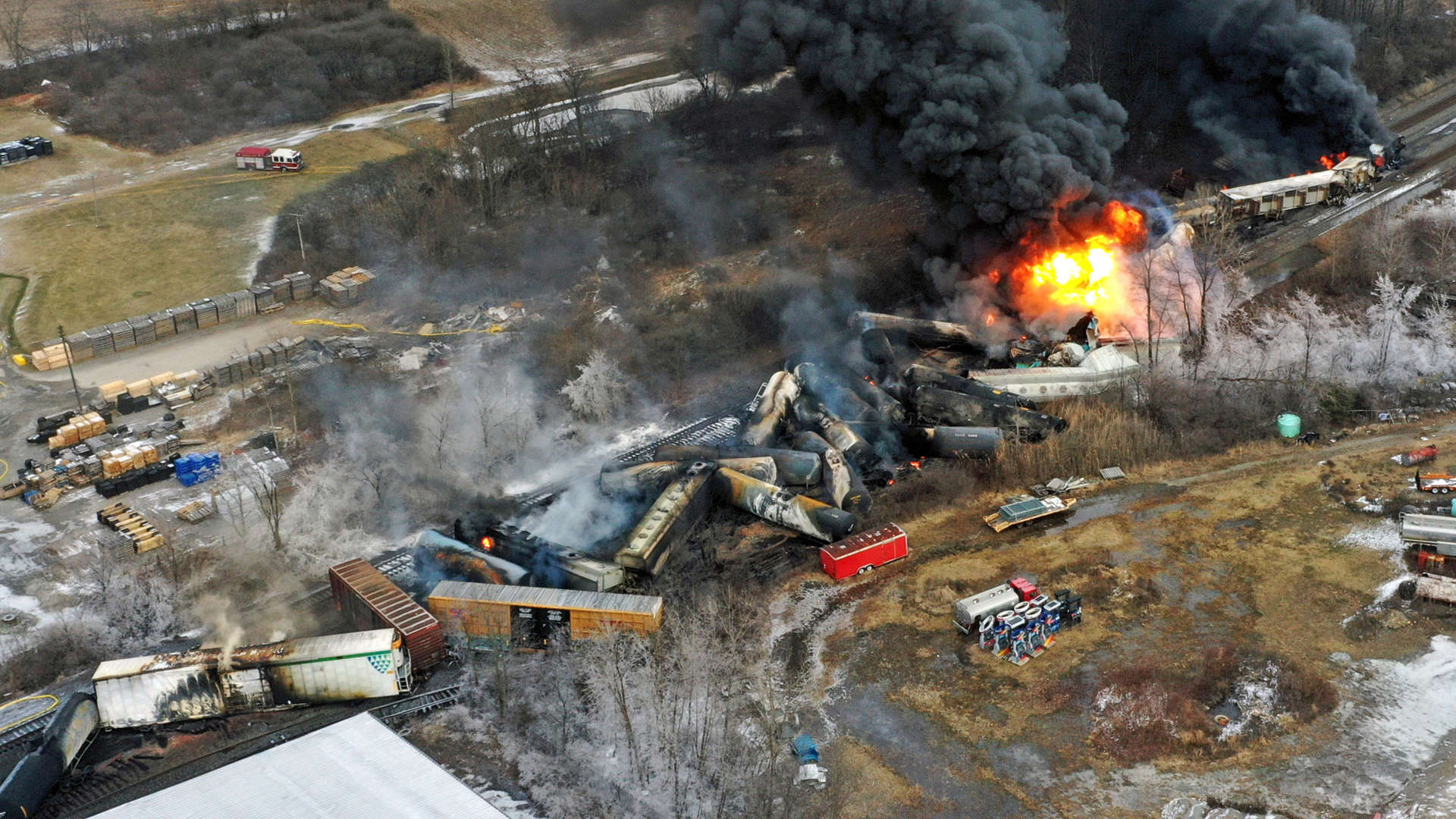
A drone photo shows portions of a Norfolk Southern Railroad freight train that derailed in East Palestine, Ohio. More than 100,000 gallons of vinyl chloride were released and burned.
© Gene J. Puskar, AP
During a virtual press conference, Mike Schade, the program director at Toxic-Free Future, remarked, “The East Palestine train derailment is emblematic of that risk.” Since the incident, residents of East Palestine and nearby areas have reported a range of concerning health symptoms, including headaches, sore throats, eye irritation, and coughing. Schade emphasized that “people who live near facilities involved in the production of vinyl chloride face those risks and more,” noting that “these communities are disproportionately low-income and minority.“
He added, “It is deeply troubling that more than 10 billion pounds of vinyl chloride are produced in a year, and low-income communities and communities of color are bearing the brunt of these harmful exposures.”
We all know that lead is toxic, but so is PVC pipe, which is known as the poison plastic. If EPA is truly committed to environmental justice, they would ban local and state governments from using PVC pipe to replace lead service lines.
Health Implications of Phthalate Exposure
Phthalate exposure has been the subject of intensive research due to concerns about their role as endocrine disruptors. Endocrine disruptors interfere with hormone functions and have been linked to several health issues, including reproductive and developmental anomalies, as well as metabolic and immunological disorders.
A systematic review by Bornehag et al. (2004) examined the association between phthalate exposure and asthma and allergies in children. The study concluded that high levels of phthalates, which can originate from PVC products in indoor environments, may modulate immune responses and contribute to the onset of asthma and allergic symptoms in susceptible populations (Bornehag et al. 2004). These findings are particularly concerning for anyone who is seeking to mitigate exposure to compounds capable of disrupting normal hormonal functions.

While the adverse effects of phthalates on reproductive and developmental health have been studied extensively, it is important to note that the chronic exposure resulting from gradual PVC leaching may also have cumulative effects over a lifetime. Even low-level exposure, if sustained, might pose risks that are not immediately apparent. This points to the need for continued research and comparative studies on long-term exposure, as well as the potential for interactions between phthalates and other environmental contaminants.
In addition to phthalates, the degradation of PVC may also result in the formation of nano- and microplastics. Zhang et al. (2024) noted that aging PVC pipes can contribute to microplastic pollution in drinking water distribution systems. While the health impacts of microplastics remain an emerging area of study, there is growing concern that they could serve as carriers for other chemical contaminants or even cause mechanical disruptions within biological systems (Zhang et al. 2024).
Regulatory Perspectives in North America and Europe
Given the growing body of evidence regarding the risks associated with PVC leaching and phthalate exposure, regulatory bodies in different regions have taken steps to address these concerns. However, the regulatory landscape is not uniform across the globe.
In North America, the U.S. Environmental Protection Agency (EPA) has implemented measures such as the Lead and Copper Rule to control the leaching of metals in drinking water systems. However, there is a noticeable gap in regulations specifically targeting the leaching of phthalates from PVC pipes. The EPA has not yet established legally enforceable limits for phthalate content in drinking water, leaving a regulatory void concerning the safety of PVC-based water distribution systems (EPA 1991, Beyond Plastics 2023).

Conversely, European regulatory agencies have been more proactive in restricting the use of phthalates. The European Chemicals Agency (ECHA) has identified substances such as di(2-ethylhexyl) phthalate (DEHP), dibutyl phthalate, and diisobutyl phthalate as chemicals of very high concern due to their adverse effects on human health and the environment. Under the REACH regulation, the use of these phthalates is restricted in various consumer products, which is indicative of the precautionary principle adopted in Europe (ECHA 2021). Although these measures are not directly aimed at drinking water systems, they reflect a broader regulatory effort to limit phthalate exposure in all consumer contexts.
The contrast between North American and European regulations underscores the importance of region-specific policies when evaluating drinking water safety. As research continues to expose the potential hazards linked to PVC leaching and phthalate exposure, it is likely that North American regulatory frameworks may eventually be adapted to reflect these new insights. In the meantime, consumers and water system managers in North America must rely on supplementary measures and best practices to mitigate risks.
Mitigation Strategies for Reducing Health Risks
Addressing the potential health risks posed by PVC pipes in drinking water systems requires a multi-faceted approach. Both infrastructure management and water treatment practices can be modified to reduce the hazards associated with PVC leaching.
One of the primary strategies involves optimizing water retention times within distribution systems. As indicated by the research conducted in Saudi Arabia, longer retention times are associated with increased levels of chemical leaching (Al-Malack 2001). By minimizing the time water is stored in PVC pipe networks, the accumulation of leached contaminants can be reduced, thereby enhancing overall drinking water safety.
Another effective approach is the reassessment and modification of water treatment processes. The study by Maliwan et al. (2025) highlights that
chlorine disinfection, although crucial for controlling microbial contamination, can inadvertently accelerate phthalate release.
Water utilities may need to explore alternative disinfection methods or adjust chlorination protocols to balance microbial safety with the reduction of chemical leaching. Advanced treatment methods, such as activated carbon filtration or advanced oxidation processes, might also be integrated into water treatment plants to capture or degrade phthalates before they reach the consumer.
Emerging technologies, such as pipe lining or the installation of barrier coatings on the interior surfaces of PVC pipes, offer promising avenues for reducing direct contact between drinking water and the pipe material. These coatings create a barrier that can potentially mitigate the leaching of phthalates and other contaminants, thereby enhancing the safety and longevity of water distribution systems.
On the policy front, strengthening regulatory oversight regarding PVC-related contaminants is critical. In regions where formal limits on phthalate exposure are not yet established, ongoing monitoring and risk assessment programs can help to identify problem areas and drive policy updates. Collaboration between regulatory bodies, water utilities, and scientific researchers is essential to develop comprehensive guidelines that address both microbial and chemical contaminants effectively.

For health-conscious consumers, it may also be prudent to invest in point-of-use water treatment devices. Home filtration systems that are capable of removing phthalates and other organic contaminants can serve as an additional safeguard, particularly in older distribution systems known to use PVC pipes. Although such devices do not address the root cause of PVC leaching, they provide immediate relief by reducing exposure levels at the consumer level.
Conclusion
The extensive use of PVC pipes in drinking water systems, while economically and logistically advantageous, presents a potentially under-recognized threat to drinking water safety due to PVC leaching. Scientific studies indicate that contaminants such as phthalates and other volatile organic compounds can migrate from PVC pipes into drinking water under various conditions, including prolonged contact and the use of chlorine disinfection. These contaminants are associated with various negative health outcomes, most notably reproductive and developmental effects, as well as a possible contribution to asthma and allergies in children.
Globally, research reinforces the need for continued surveillance and improved water management practices. The evolving regulatory approaches—more comprehensive in Europe than in North America—highlight a clear need for more stringent and focused policies regarding PVC leaching and phthalate exposure in drinking water systems.
Mitigation strategies that focus on reducing water retention times, revising disinfection procedures, and incorporating advanced filtration and pipe lining technologies are essential to minimizing the risks associated with PVC leaching. For consumers, integrating point-of-use treatment devices can provide a practical measure to reduce phthalate exposure. Ultimately, a combined effort from water system managers, policymakers, and researchers is required to safeguard public health while maintaining the benefits provided by PVC pipe infrastructure.
By staying informed about emerging research and advocating for improved regulatory measures, health-conscious consumers can contribute to ensuring that drinking water remains safe, healthy, and free from potentially harmful contaminants.

Body-Field Scan
Ready to find out what’s impacting your energy levels by using our bioenergetic scanning technology. Check out your body’s energy with a Body-Field scan and gain deeper insight into your holographic self with our certified Bioenergetic Practitioner. For an In-Clinic visit click here, or, for a Telehealth (remote) session click here.
We offer a completely new, alternative and bioenergetic healthcare approach based on 21st century science, technology and quantum physics with personalized, holistic therapy solutions such as, our unique BioScalar Infusion℠ therapy, Bioenergetic body-field scan technology, miHealth biofeedback, PEMF, Rife and Vibroacoustic (VAT) therapies that can restore optimal health and well-being throughout the body, mind and spirit in the most natural way. Let us help you restore your health and energy!